
Mifflin County Criminal Court Records
A criminal court record is the case-level record kept by the court after charges are filed. In Mifflin County, the Clerk of Courts handles new criminal court cases transferred from Magisterial District Judges, along with criminal fines, costs, restitution, criminal bench-warrant orders, and bail paperwork for the Court of Common Pleas. The record can include charge rows, OTN, complaint or incident number, hearing events, pleas, motions, disposition, sentence, probation, fines, costs, and restitution.
Mifflin County criminal court records often begin with an MDJ event. The MDJ offices handle preliminary arraignments, bail, search warrants, summary offenses, and preliminary criminal matters. If a felony or misdemeanor case is held for court, it moves into the Mifflin County Court of Common Pleas at 20 North Wayne Street in Lewistown. The Court of Common Pleas lists President Judge Aaron L. Gingrich and Judge Jonathan W. Reed. The full case file and outcome belong in the criminal court record, while the narrower charge detail is covered in Mifflin County arrest records and court charges.
Search Mifflin County Criminal Records
The first online search path is Pennsylvania UJS Case Search. Search by participant name, docket number, OTN, complaint number, incident number, SID, organization, or calendar event when those facts are known. UJS can show public criminal docket sheets for Common Pleas and MDJ matters, but it is not a Pennsylvania State Police criminal-history background check. The local Clerk of Courts remains the contact for certified copies and file questions.
- Choose the search mode that fits the known fact, such as participant name, OTN, docket number, complaint number, or incident number.
- Filter by Mifflin County and court type when statewide results are too broad.
- Open the criminal docket and compare the defendant, case type, court, dates, and charge rows.
- Read the docket entries for arraignment, hearings, motions, pleas, disposition, sentence, bail, and financial obligations.
- Contact the Clerk of Courts at 717-248-8146 when a certified copy or non-online filing is needed.
Criminal fines and costs may route through the county ePay link or PAePay when the obligation is approved for online payment. Bail posting through the Prothonotary and Clerk of Courts office is listed for Monday through Friday, 9:00 AM to 2:30 PM, with after-hours bail at the Mifflin County Correctional Facility.
Mifflin County Criminal Case Flow
Criminal court records should be read as a sequence. The early events may occur before an MDJ, where preliminary arraignment, bail, search warrant activity, citation or complaint events, and preliminary hearings can appear. If the matter is transferred, the Common Pleas docket shows the later case file, including motions, conferences, plea or trial events, disposition, sentencing, and financial entries.
Case flow: Charges Filed › Preliminary Arraignment › Preliminary Hearing › Common Pleas Transfer › Pretrial and Motions › Plea or Trial › Disposition › Sentencing
| Stage | What Happens |
|---|---|
| Charges filed | A complaint, citation, OTN, or incident-linked entry starts the court charge record. |
| Preliminary arraignment | The MDJ may address charges, bail, and initial appearance requirements. |
| Preliminary hearing | The MDJ decides whether a misdemeanor or felony case moves to Common Pleas. |
| Pretrial and motions | The Common Pleas docket may show motions, orders, hearings, and continuances. |
| Plea or trial | The docket records the plea, verdict, or other formal outcome event. |
| Sentencing | The record may show sentence, probation, fines, costs, restitution, and payment entries. |
Mifflin County Criminal Record Fields
The criminal court record is broader than the arrest entry. It can show the filed charges, the court path, and the outcome. UJS docket sheets commonly show a header, party data, criminal metadata, docket entries, and financial entries. Recent entries may lag, and some filings may not be visible online. Use the docket to identify the case, then request official copies from the Clerk of Courts when needed.
| Field | What It Shows |
|---|---|
| Docket number | The court case number used to search and request the criminal file. |
| Defendant and parties | The defendant, attorneys, prosecutor or agency, and party roles when entered. |
| OTN and identifiers | Offense tracking number, complaint number, incident number, or SID when public. |
| Charges | Offense description, statute, grade, counts, offense date, and charge status. |
| Docket entries | Filings, orders, notices, hearings, continuances, pleas, and disposition events. |
| Disposition | How each charge or the case was resolved, such as guilty, dismissed, or other outcome. |
| Sentence and finances | Sentence, probation, fines, costs, restitution, bail, and payment-plan entries when entered. |
Mifflin County Criminal Offices
The Mifflin County District Attorney prosecutes criminal activity throughout the county, recommends appropriate punishment, assists victims, and works with law enforcement and community partners. The listed District Attorney is Christopher Torquato. The office is at the Mifflin County Courthouse, 20 North Wayne Street, Lewistown, PA 17044, with phone 717-248-9800. Crime Victim Services is listed at 717-242-3372.
The District Attorney source image is from the county DA office page.
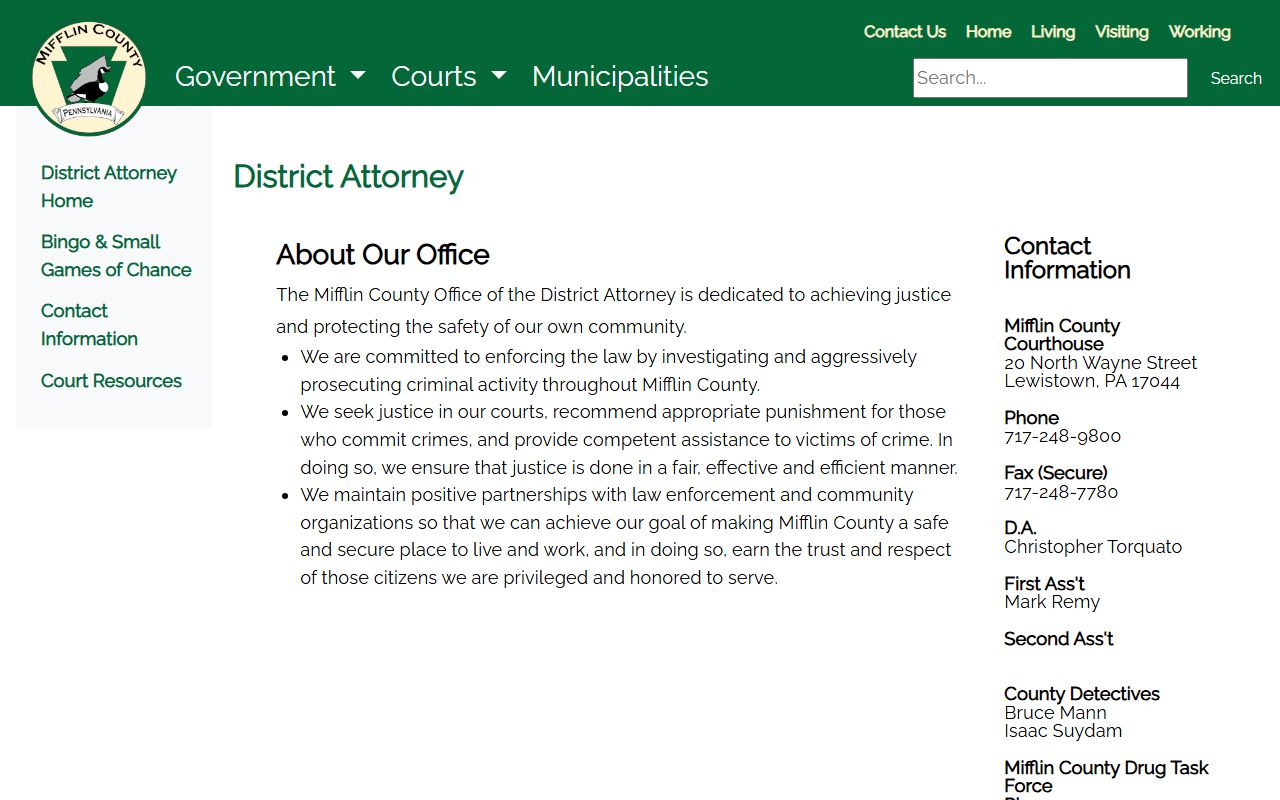
The DA office role explains why a criminal record may show prosecutorial decisions after the original charge event.
The Mifflin County Public Defender represents eligible people who lack funds for private counsel and face misdemeanors, felonies, certain summary cases with possible incarceration, juvenile allegations, or qualifying mental-health commitment matters. Chief Public Defender Shawn Curry is listed, and the office phone is 717-914-6590.
The Public Defender source image comes from the county public defender page.
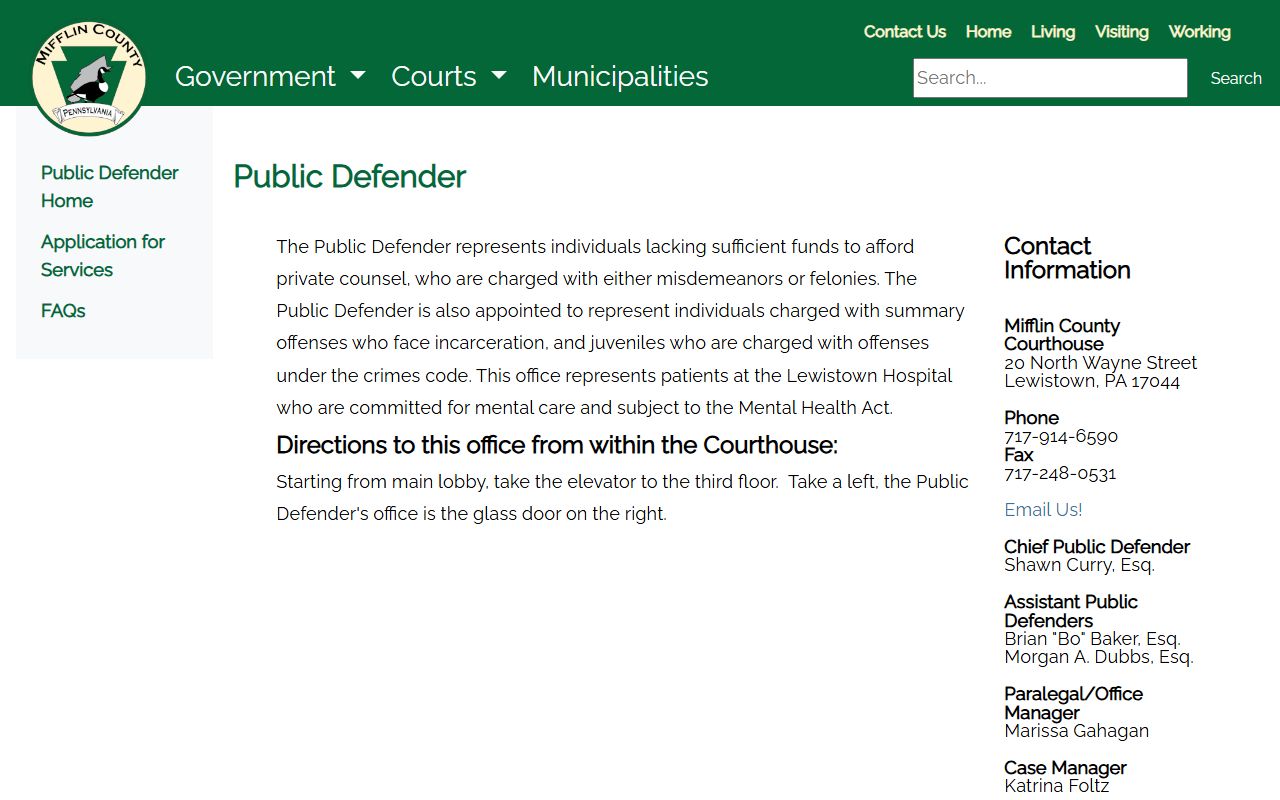
Defense representation can appear indirectly in criminal court records through attorney entries, motions, hearing events, and disposition history.
Criminal Charges vs Convictions
A charge is an accusation filed in court. A conviction is an outcome after a guilty plea, verdict, or other adjudication that results in a finding of guilt. Mifflin County criminal court records may show charges that are later amended, withdrawn, dismissed, held for court, reduced, or resolved in different ways. Read each charge row with its disposition instead of assuming that every filed charge became a conviction.
| Point | Charge | Conviction |
|---|---|---|
| Meaning | A formal accusation in the case record. | A guilty plea, verdict, or finding reflected by disposition. |
| Timing | Appears early or may be amended as the case moves. | Appears after plea, trial, or other case resolution. |
| Use | Shows what was alleged and filed. | Shows the outcome tied to sentence or penalty. |
| Risk | Can be misread if disposition is ignored. | Must still be checked for sentence, appeal, or later relief. |
Sealed vs Expunged Records
Some criminal court records are restricted after a court order or by statute. Pennsylvania expungement under 18 Pa.C.S. 9122 is different from limited access under 18 Pa.C.S. 9122.1. Juvenile files are separately restricted under 42 Pa.C.S. 6307. Mifflin County's forms page links an ARD Application for and Dismissal of Charges Application and points other expungement users to statewide court forms.
| Point | Limited Access or Sealed | Expunged |
|---|---|---|
| Public view | Restricted from normal public access. | Removed from public access according to the order and law. |
| Common route | Petition-based limited access for eligible records. | Expungement petition or ARD dismissal/expungement route when eligible. |
| Where to start | Identify docket number, OTN, charges, and disposition. | Use Mifflin County or statewide court expungement forms as applicable. |
The Right-to-Know Law source image is from the Pennsylvania RTKL text.
RTKL is relevant for agency records, while criminal case records are still governed by judicial access policy.
The expungement statute source image comes from 18 Pa.C.S. 9122.
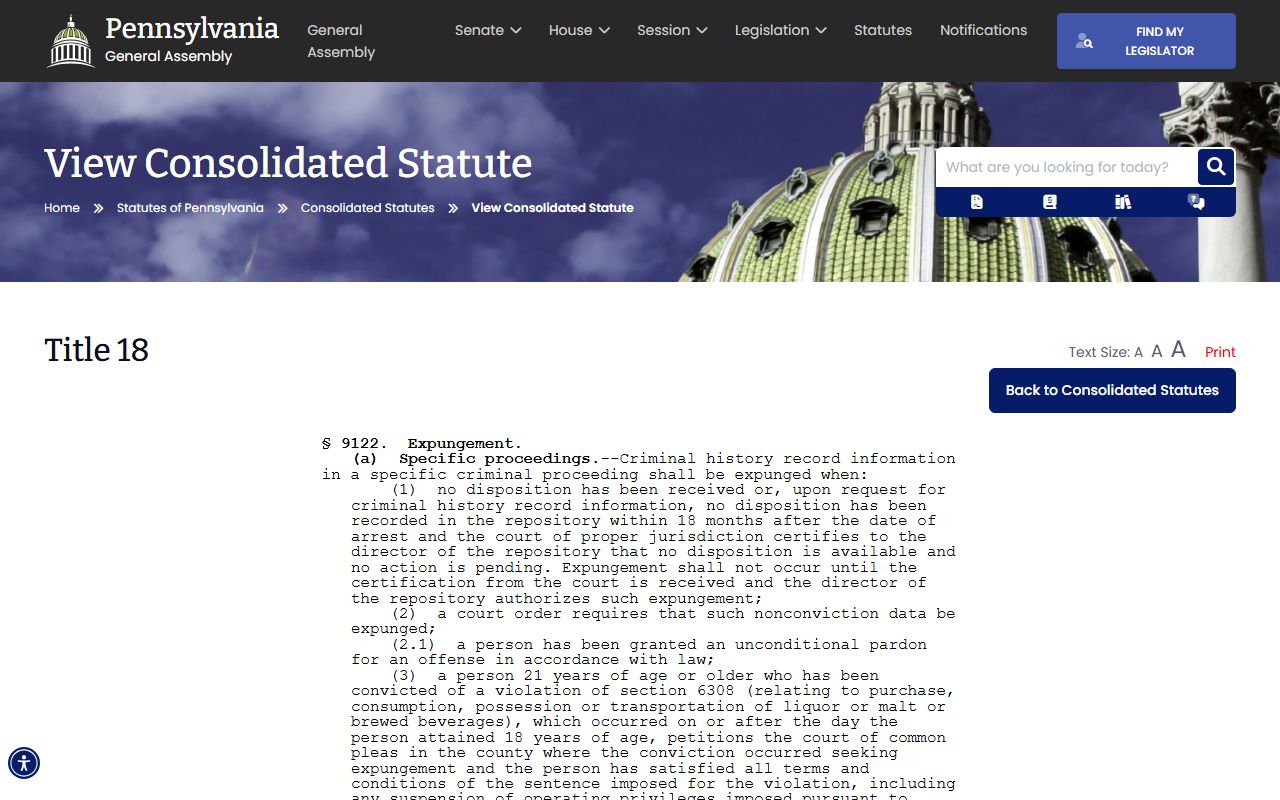
That statute is the core research source for explaining when an expungement path may remove criminal-history information from public access.
The limited-access source image comes from 18 Pa.C.S. 9122.1.
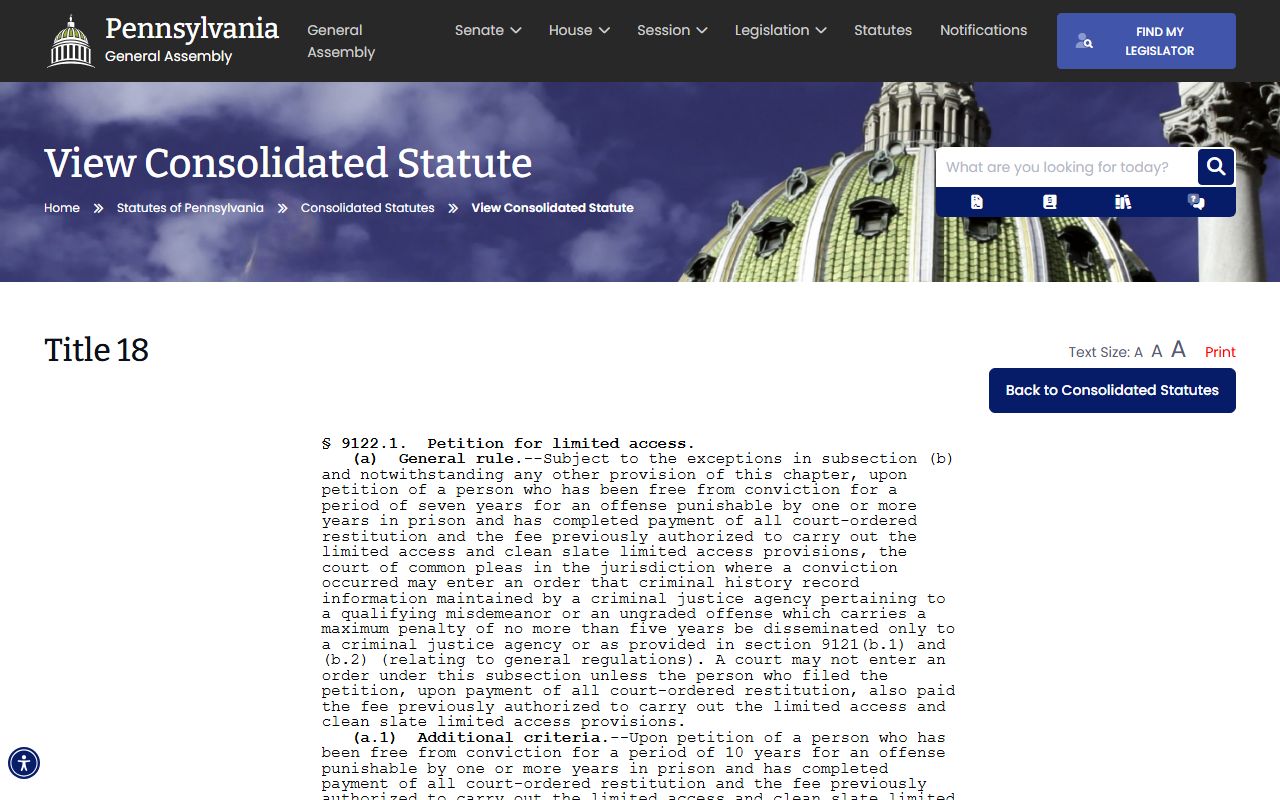
Limited access is the sealing-style restriction that can hide eligible criminal records from normal public lookup.
Mifflin County Criminal Access Limits
Public criminal dockets are available through UJS when not restricted, but they have limits. UJS says recent entries may not appear immediately and docket sheets should not be used instead of a criminal-history background check. Pennsylvania State Police is the criminal-history background check source. Employers and others using records for employment, housing, credit, insurance, or similar purposes must follow the law that applies to those decisions.
Important: A criminal docket may show accusations, not just convictions, so always read each charge disposition.
Restricted records include juvenile matters, expunged or limited-access records, sealed cases, mental-health matters, confidential identifiers, victim information, and abuse-victim addresses. When the online docket is unclear, use the Clerk of Courts or the issuing MDJ office to confirm what can be released.